Paleotemperature signals and "bioarchitecture" in ammonite mandibles
Principal Investigator at ZRC SAZU
Tim Cifer, PhD-
Original Title
Paleotemperature signals and "bioarchitecture" in ammonite mandibles
Project Team
Anja Kocjančič, Prof. Aleksander Horvat, PhD-
ARIS Project ID
N1-0485
-
Duration
1 March 2026–28 February 2029 -
Link to SICRIS
24230 -
Lead Partner
Research Centre for Astronomy and Earth Sciences, Institute for Geological and …
-
Project Leader
-
Financial Source
ARIS

NKFIH

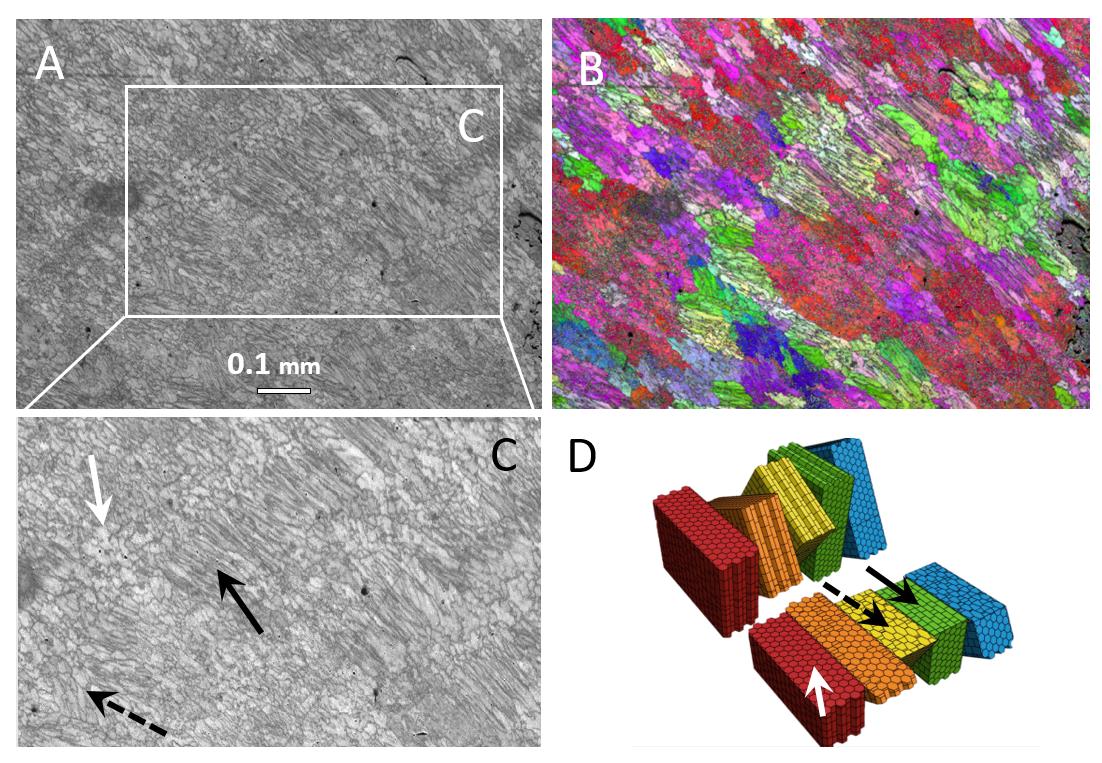
As the climate of the Mesozoic is equivalent to the extreme end of current global warming, its research can help refine climate models by providing accurate paleotemperature data. This requires the analysis of formations resistant to diagenetic alteration (e.g., calcitic fossils). Oxygen isotope thermometry, the temperature dependence of the carbonate-water 18O/16O fractionation, is indispensable for determining paleotemperatures and has wide applications on belemnites and brachiopods. Very little data is available for aptychi, and no data exist for rhyncholites. We have already studied the internal structure of Jurassic Laevaptychus and detected a laminated layer preserving the primary paleotemperature signals. The question arises whether the observed lamination reflects environmental changes, metabolic changes, or another phenomenon. Based on the preliminary application of mean-field theory of planar mosaics on EBSD fabric images, the lamination contains a complex calcite structure that is similar to a Bouligand structure (a polyhedral tessellation consisting of layers built from aligned prismatic bundles rotated relative to each other), which is known to improve mechanical strength in biomaterials.
Main goals of the present proposal are:
(1) Investigate the microfabric and structural characteristics of Laev- and Lamellaptychus to determine the origin, function, and evolution of the laminated structure.
EBSD-based microfabric and crystallographic structure images will be digitized, and the mosaic structures will be modelled based on polygonal images using the mean-field theory of planar mosaics. This will help to quantify the structural differences between aptychus species. The combined optical and cathodoluminescence microscopic and EBSD analyses will also be used to detect diagenetic alterations.
(2) Determine the relevant calcite-water oxygen isotope fractionation relationship to provide precise paleotemperature calculations.
The unique fractionation relationship of a calcitic fossil is due to the vital effect (i.e. metabolic processes) of the organism on calcite-water oxygen isotope fractionation. Clumped isotope analyses will be conducted on diagenetically unaltered samples. In contrast to oxygen isotope thermometry, clumped isotope analysis provides direct paleotemperature data without needing to know the composition of the water. These results together with aptychus oxygen isotope compositions and presumed seawater compositions, can yield a relationship between calcite-water oxygen isotope fractionation and temperatures.
(3) Gather precise and reliable paleotemperature data.
We aim to collect Jurassic–Cretaceous aptychi, rhyncholites, belemnites, and brachiopods from Hungarian, Slovenian and other European occurrences to investigate structural and geochemical variations across space and time. We expect to improve the records of seawater temperatures for different ages and paleo-latitudes. Samples with finely laminated layers will be investigated using high-resolution oxygen isotope ratio measurements by SIMS (SwissSIMS, University of Lausanne) to detect internal, lamination-related oxygen isotope variations.